Showing posts with label Flexibility. Show all posts

Thursday, 29 October 2015

Alexi Marmot to speak on Bath Spa University’s uncommon Commons

How are university buildings evolving to accommodate new ways of teaching and learning? Alexi Marmot will be addressing this question when she speaks at next month’s Education Estates conference in Manchester http://www.educationestates.com/conference/

Alexi will describe how AMA helped to articulate and deliver a new vision for the Commons building at Bath Spa University. Design Director David Jenkin led the interior strategy, consultation and design. Commons is a fascinating, flexible and innovative new facility. Designed by Cube Design and opened in 2014 by David Puttnam, it is the university’s largest building at 8,000 sq m and the hub of the Newton Park campus.
Lord Puttnam opening the Commons building
Source: bathspa.ac.uk
Commons was conceived as a different type of university building. Providing learning, teaching and meeting spaces, staff work bases and major specialist digital studios, it needed to be highly flexible, fit for the current and next generation of students and staff.
Different furniture and space types encouraging a range
of activities
The university recognised that a different approach was needed for the shell and the interior, says Alexi: “Both architectural and interior workstreams maintained an inventive and collaborative approach, allowing each to focus on their different domains: one on the building fabric to create a robust shell, naturally ventilated, energy efficient, and the other on end users and anticipating future change in university activities.”
Spaces encouraging collaborative working
The new building represents quite radical change for the university.  Staff and students share the same building, and many of the same facilities. Academic staff work in a club-type zone with few conventional workplaces, none individually owned. Elsewhere, teaching rooms are interspersed with breakout and group study areas in local hubs. Interactive group learning spaces, individual and quiet study areas, are provided generously on the ground floor alongside a design lab, recording studio, and large flexible conference room.
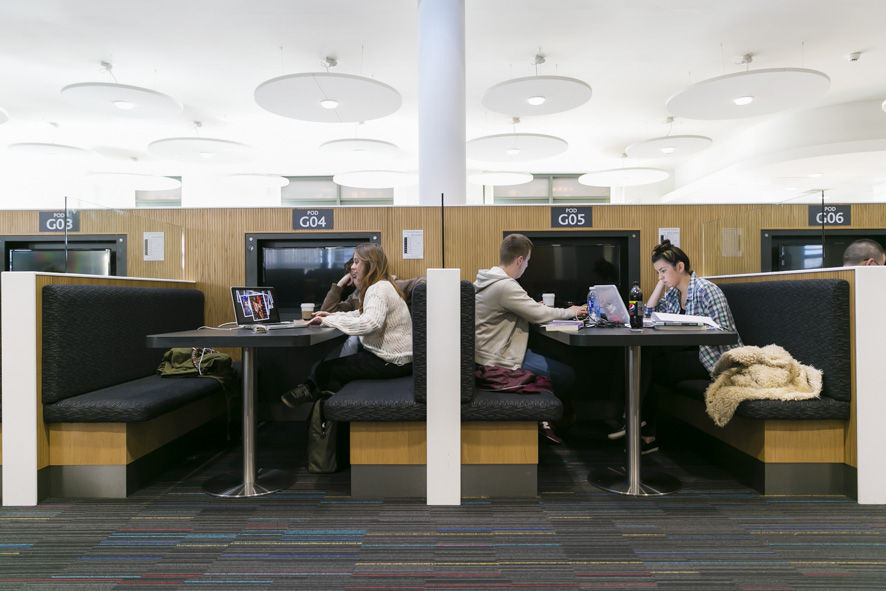
Part contained spaces provide some intimacy

“The new building was immediately popular with students following its launch in mid-2014,” says Alexi, “and is full of their energy and enthusiasm.” Commons was a runner-up in the Buildings that Inspire category of the Guardian’s University Awards this year http://www.theguardian.com/higher-education-network/2015/mar/19/buildings-that-inspire-category-award-winner-and-runners-up

Tuesday, 6 October 2015

Flexible space goes corporate


Alexi Marmot has contributed to a Guardian article on co-working spaces. She says: “They are the latest incarnation of serviced offices or office hotelling, selling fully fitted out and equipped space including receptionists, coffee and access to meeting rooms only for the duration over which they are needed. Expensive, inflexible and long leases for corporate offices are no longer essential and indeed seem increasingly questionable, particularly if the occupants in any case don’t like working there”

The article looks at the rise of flexible and shared space, coinciding with the millennial generation entering the workforce. The impact on the traditional property world is also covered as “the concept of flexible space has become firmly entrenched in the corporate world, both for the short-term - when sales reps need meeting spaces for presentations and for longer projects.”


Wednesday, 23 September 2015

Do universities need ‘iconic’ buildings?

In an article for the Guardian Higher Education Network, Alexi Marmot questions the benefits of buildings commissioned to make an impact.

Bath Spa University Commons - fit-out by AMA 
Spaces encouraging collaborative working
Ambitious university leaders bring together “starchitects” and wealthy sponsors eager to provide funds for flagship buildings. Starchitects play with the ideas of crumbling buildings, irregular shapes and angular geometries, rather than conventional vertical planes and rectilinear structures. Their designs hint that universities are organisations whose mission is to question traditional ways of thinking, to break down conventions.

Do such ambitious buildings really work for the staff and students for whom they are designed? What aspects of the new buildings stimulate better teaching, learning and research? Might more restrained and elegantly designed buildings meet university requirements just as well? Can unpretentious, cheap buildings erected rapidly by design and build contractors, satisfy users?

We need much more solid evidence to answer these questions with conviction. Research on “post-occupancy evaluation” – how buildings are perceived by those who use them – is still rather unusual, although it is always recommended. University estate directors have collaborated on a methodology for conducting post-occupancy evaluation through the Higher Education Design Quality Forum (HEDQF) – but few apply it.

National Student Survey results for 2015 show that 86% of undergraduates are satisfied with their learning resources (library, IT and access to specialised equipment, facilities and rooms.) Good news, but it does not illuminate whether particular buildings or features are positive.

Other research shows that the staff are generally less satisfied with their facilities than students are, which could mean they negatively impact on their research and teaching. But this year’s sector efficiency report led by Sir Ian Diamond rates 85% of HE space as good to excellent.

Radical shifts in the way students earn and digital technologies for teaching and learning - virtual learning environments, lecturecasts, online quizzes, webinars, skype tutorials, flipped classrooms, Moocs - make new demands on buildings, data connectivity and infrastructure. They also raise the prospect that education can be delivered without going to a place called a university.

When asked their views, students commonly complain about poor internal air quality and temperature, and express the need for more spaces for group work with their peers, more computers and computer rooms. They want “make spaces” for creative experimentation, and more social learning spaces, and they want these spaces to be open 24/7.

All university buildings – the new and the old – need to respond to evolving requirements. Flexibility and adaptability through time is one of the most precious attributes of all HE buildings.

European universities and their architecture have already endured for more than a millennium, and more than 800 years in the UK. All have grown dramatically in the last century and continue to grow, even as online learning accelerates. Their future success and survival will be aided by better and more adaptable buildings, based on a well-researched evidence base.


UA-53860150-2